
Microchip PIC18F27Q43-I/SS: An In-Depth Technical Overview and Application Guide
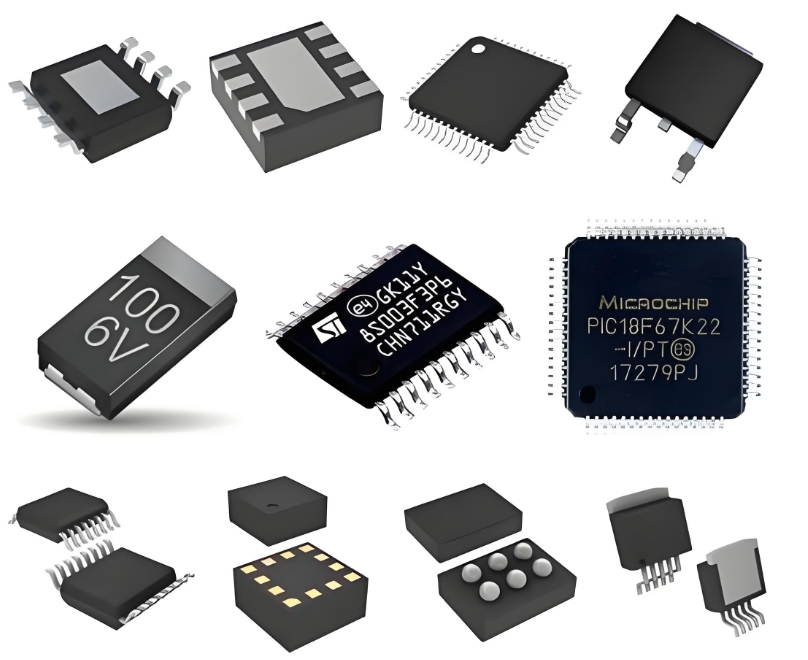
The Microchip PIC18F27Q43-I/SS represents a significant evolution within the venerable PIC18 family, engineered to meet the demands of modern embedded systems that require a blend of robust core performance, advanced peripherals, and enhanced connectivity. This 28-pin microcontroller (MCU), packaged in the SSOP (Shrink Small Outline Package), is a powerhouse of integration, making it an ideal candidate for a vast array of applications, from industrial control and automotive subsystems to consumer electronics and IoT edge nodes.
Core Architecture and Performance
At its heart, the PIC18F27Q43 is built upon an 8-bit enhanced mid-range core with a pipelined architecture, enabling it to execute most instructions in a single cycle. Operating at speeds up to 64 MHz, it delivers a powerful 16 MIPS (Million Instructions Per Second) performance. A key feature of this core is its hardware multiplier, which accelerates mathematical computations crucial for digital signal processing and control algorithms. This MCU is further bolstered by Core Independent Peripherals (CIPs), which operate without constant CPU intervention, freeing up processing bandwidth for more complex tasks and enabling deterministic response to critical events.
Memory Configuration and Flexibility
The device boasts a substantial 128 KB of Flash program memory, providing ample space for sophisticated application code. It is complemented by 8 KB of RAM for volatile data handling and a dedicated 1 KB of Data EEPROM for storing non-volatile parameters like calibration data or user settings. The Memory Access Partition (MAP) feature is a standout, allowing developers to assign specific sections of memory to application or boot code, thereby enhancing security and facilitating robust bootloader and Over-The-Air (OTA) update implementations.
Advanced Peripheral Integration
The peripheral set of the PIC18F27Q43 is where it truly shines, designed to interface with a wide range of sensors, actuators, and communication networks.
Analog Capabilities: It includes a 12-bit Analog-to-Digital Converter (ADC) with Computation (ADCC), which can perform averaging, filtering, and threshold comparisons autonomously. A 5-bit Digital-to-Analog Converter (DAC) and two comparators provide additional analog front-end flexibility.
Connectivity: For communication, the MCU is exceptionally well-equipped. It features multiple serial communication modules configurable as UART, SPI, or I²C (including SMBus and PMBus). Most notably, it integrates a CAN FD (Flexible Data Rate) 2.0b controller, a critical peripheral for robust automotive and industrial network applications.
Timing and Control: The device includes a rich set of timers, including 16-bit and 8-bit timers, a Hardware Limit Timer (HLT) for precise pulse control, and a Windowed Watchdog Timer (WWDT) for increased system reliability.
Direct Memory Access (DMA): Multiple DMA controllers allow for efficient data transfer between peripherals and memory, drastically reducing CPU overhead and power consumption.
Development Ecosystem and Tools
Accelerating development for this MCU is a mature and comprehensive ecosystem. The MPLAB® X Integrated Development Environment (IDE) and the XC8 compiler are the primary software tools. For hardware, the Curiosity Nano board offers an excellent platform for prototyping and debugging. The MPLAB Code Configurator (MCC), a graphical plugin, is indispensable for quickly initializing the complex peripheral set, generating driver code, and dramatically reducing development time.
Application Guide
The PIC18F27Q43's feature set makes it suitable for a diverse range of applications:
Industrial Control: Its CAN FD connectivity, robust CIPs (like CLC and HLT), and high-noise immunity make it perfect for PLCs, motor control units, and sensor gateways.
Automotive: Applications include body control modules (e.g., seat/window control), lighting systems, and advanced sensor nodes, leveraging its AEC-Q100 qualification (for specific versions) and communication peripherals.
Consumer and IoT: Its low-power modes, ample memory, and communication interfaces (I²C, SPI) enable smart home devices, wearables, and other connected products.
General Purpose: It serves as an excellent upgrade path for older 8-bit designs, offering more performance, features, and efficiency in a pin-compatible footprint.
In summary, the Microchip PIC18F27Q43-I/SS is a highly integrated and versatile 8-bit microcontroller that punches well above its weight. It successfully bridges the gap between traditional 8-bit simplicity and the peripheral complexity often found in 32-bit MCUs. Its combination of a high-performance core, extensive memory with MAP, advanced analog, and critical communication interfaces like CAN FD and configurable serial com, all supported by a world-class development ecosystem, makes it an outstanding choice for engineers designing the next generation of intelligent and connected embedded systems.
Keywords: PIC18F27Q43, CAN FD, Core Independent Peripherals (CIPs), Memory Access Partition (MAP), 8-bit Microcontroller

